|

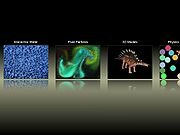
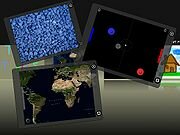
MT4j - Multitouch for Java™ - is an open source Java™ framework, created for rapid development of visually rich applications. MT4j is designed to support different kinds of input devices with a special focus on multi-touch support.
MT4j Features
- can be used for 2D, 3D or 2.5D (pseudo-3D) applications
- cross-platform - currently tested under Windows 7™, XP™, Vista™, Ubuntu Linux and Mac OSX™
- extensible, component based scene graph structure (similar to Java™'s swing framework)
- input abstraction layer - support for all sorts of input devices can be easily added
- supports the new Windows 7™ Touch features natively and all the compliant multi-touch hardware
- supports Apple™'s multi-touch mice and trackpads
- supports the TUIO protocol, which is provided by finger and object tracking software such as Reactivision, CCV or Touché
- flexible multitouch gesture system - you can define your own multitouch gestures
- the most common multitouch gestures are already included and can be registered modularly with any component for a pluggable behaviour changeable at runtime
- software or hardware accelerated graphics rendering (using OpenGL)
- includes many graphical objects e.g.: rectangles, round rectangles, ellipses, polygons, lines, triangle meshes, spheres, cubes, etc. with support for textures, gradients, fill- and outline color
- includes prebuilt UI components e.g.. buttons, text, lists, sliders and a multitouch enabled keyboard
- support for loading and fast rendering of vector graphics from Scalable Vector Graphics (SVG) files
- supports bitmap and vector fonts (SVG and True Type Fonts)
- imports 3D objects from .3ds and .obj files with textures and creates normals for smooth shading
- precise picking/selection of all geometric objects in 2D or 3D space - most gestures are supported in 3D
- animation support
- built on top of Processing, which allows you to use its many features and libraries
- test your multitouch application by using one - or even multiple mice connected to your pc (Windows, Linux)
- MT4j is open source and released under the GPL License.
Showcase: MT4j - Android Edition: First Alpha Verison
Visit the NUI Group Community
[email protected]
 contact contact
|
|